 Preset
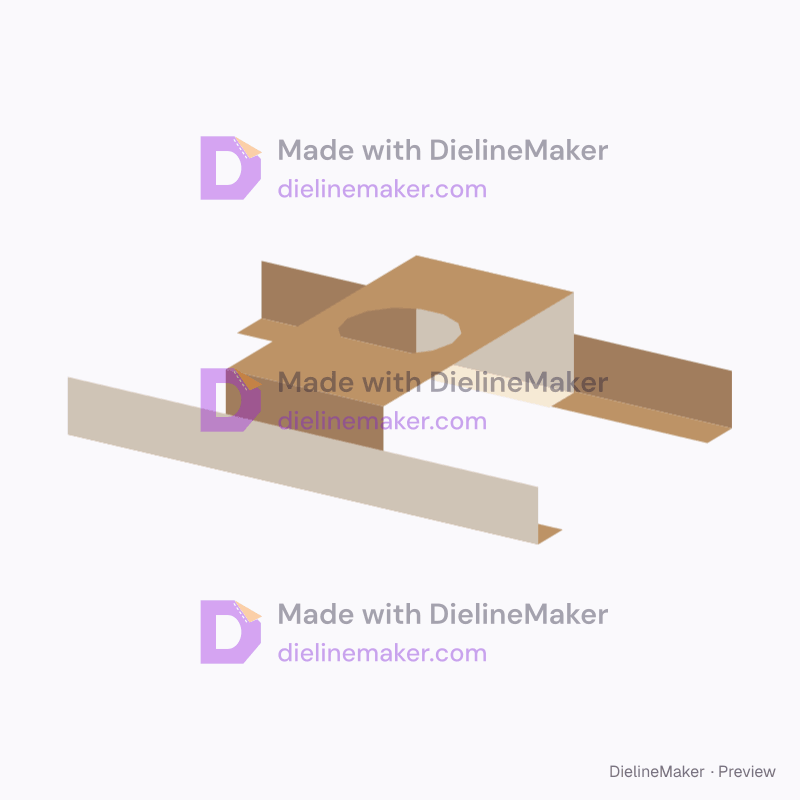
Preview image
The real blank at this size, folded by the same engine as the studio. The artwork is a sample from a fictional brand — swap in your own in the editor.
DM-INSERT-COMPONENT-SET-01Trays & lids
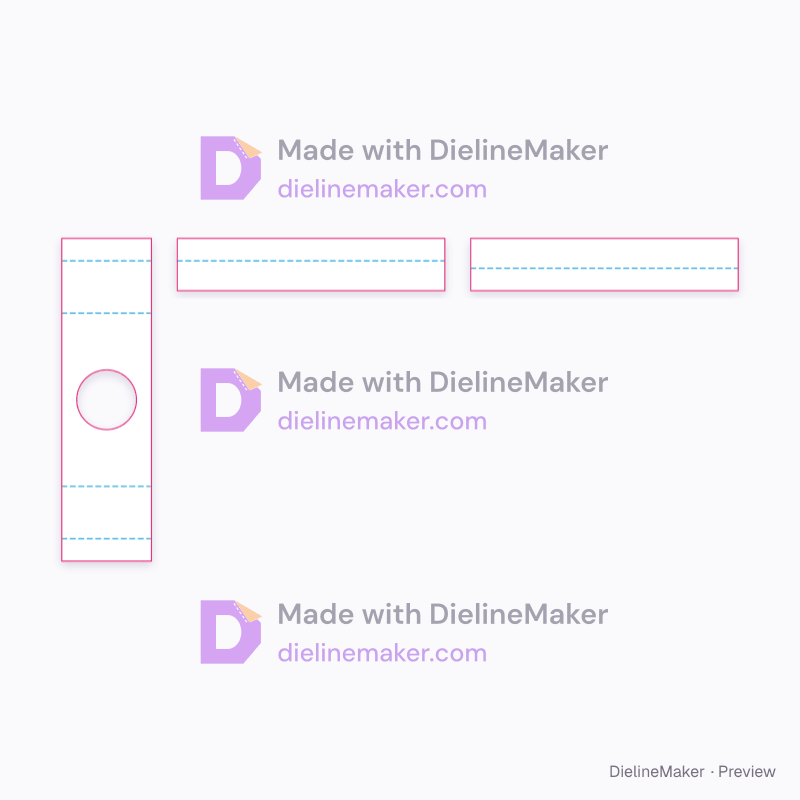
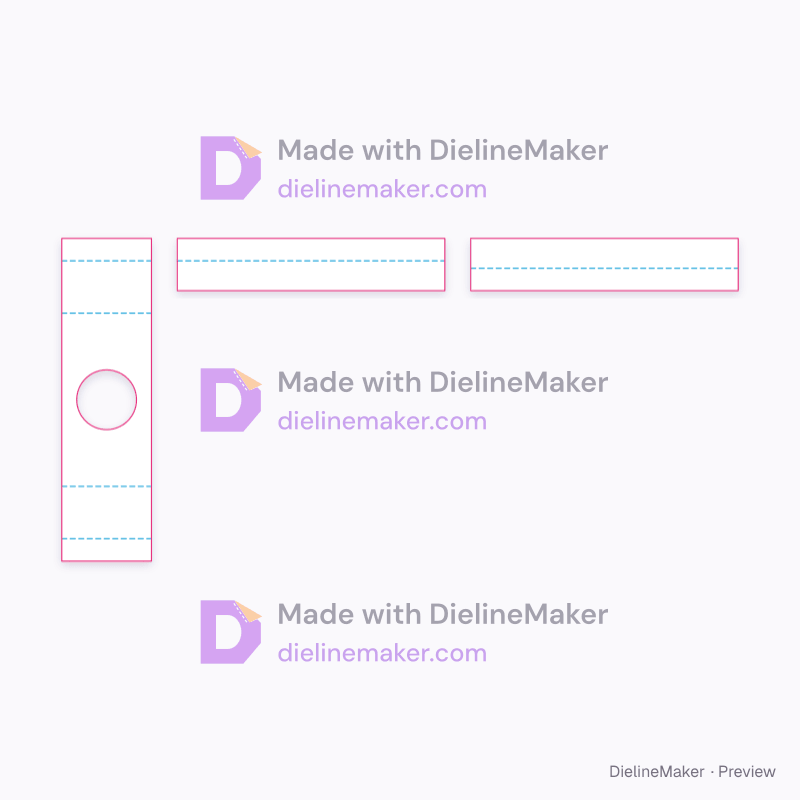
Insert component set (bridge and rails) dieline
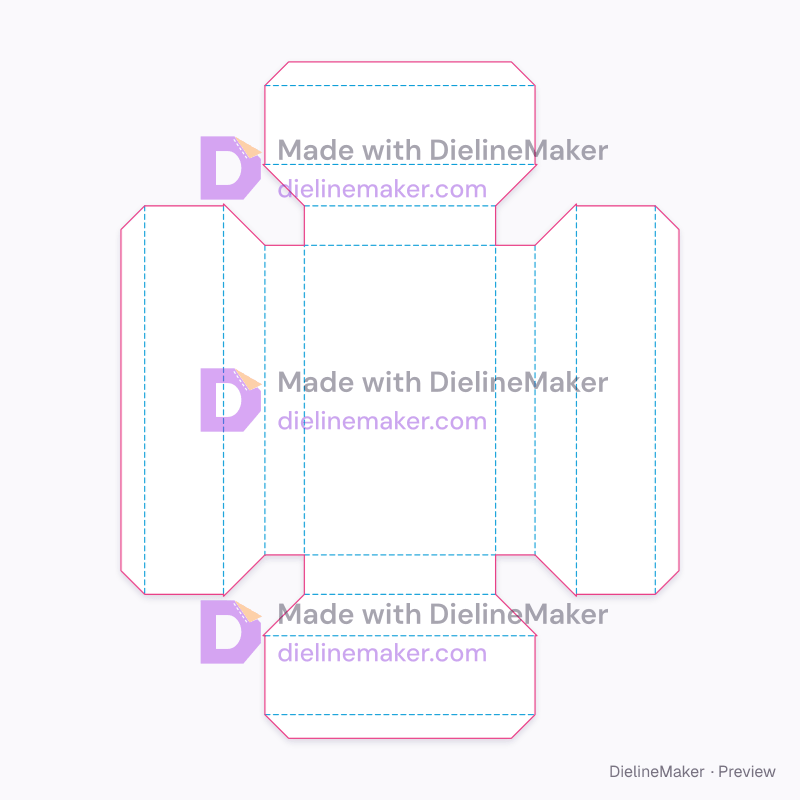
Separate folded insert pieces for a drawer or tray: an aperture bridge on legs and two L-section side rails. A parametric template — change the length, width and height and every panel, tuck and glue flap is redrawn to match.
Inside180 × 120 × 35 mm
Outside181 × 121 × 36 mm
Flat blank60 × 216 mm
Download the dielinePro
Sign in to download. Dieline downloads are part of Pro: PDF, Illustrator, SVG and DXF, cut, crease and bleed on separate layers, without a watermark. See plans
- Reference
- DM-INSERT-COMPONENT-SET-01
- Inside size
- Cavity length 180 · Cavity width 120 · Bridge height 35 mm
- Size range
- Cavity length 60–400 · Cavity width 40–300 · Bridge height 10–150 mm
- Manufacturing
- 180.5 × 120.5 × 35.5 mm score to score · inside vs outside sizes
- Parts
- 3 parts — Aperture bridge, Side rail, Side rail
- Board area
- 0.025 m²
- Default board
- SBS white board 350 g · 0.5 mm caliper
- Board options
- SBS 350FBB 400Kraft 350E-flute WSBS 18 pt
- Good for
The flat dieline
Exactly what the downloads contain, drawn from the template at its default size, with a 3 mm bleed. How to read a dieline.
- Crease
- Cut
- Bleed 3 mm
On a production sheet
Exact engine layout at the stated default dimensions: 180 × 120 × 35 mm. Stock 1020 × 720 mm, grain along width; 12 mm gripper, 10 mm tail, 6 mm sides, 5 mm gutter and 3 mm bleed. Grain rotation, automatic layout. Each part is nested separately.
45 per sheet · Aperture bridge

Proven optimal: no layout fits more than 45 ups on this sheet.
How it folds
The insert component set (bridge and rails) erects in 2 steps, in the order the creases are scored to take. The editor plays the same sequence in 3D and lights each step’s creases on the dieline.
- 1Fold the walls upBridge leg, Rail base (glued) and 2 more
- 2Fold the glue flap and glue the seamFoot and 1 more
How the blank is sized
Score-to-score panel sizes of this DM-INSERT-COMPONENT-SET-01 blank at the default size, with the formula each one follows. L, W and H are the inside dimensions; T is the board caliper (0.5 mm for SBS white board 350 g). Change the size or board in the editor and every panel is recalculated.
| Panel | Size (mm) | Formula |
|---|---|---|
| Aperture deckAperture bridge | 60 × 116 | – |
| Bridge leg ×2Aperture bridge | 60 × 35 | – × H |
| Foot ×2Aperture bridge | 60 × 15 | – |
| Rail uprightSide rail | 179 × 20 | L − 2T × – |
| Rail base (glued)Side rail | 179 × 15 | L − 2T × – |
| Rail uprightSide rail | 179 × 20 | L − 2T × – |
| Rail base (glued)Side rail | 179 × 15 | L − 2T × – |
Adjustable in the editor
Beyond the size and board, this structure exposes 3 options; the template and 3D preview follow each change.
- Aperture diametermm
- Bridge widthmm
- Rail heightmm
Ready-sized insert component set (bridge and rails) presets
The same structure with sizes, boards and options set for a use.
- Preset
Before you choose this template
Size, materials, downloads and production checks.
Will the insert component set (bridge and rails) dieline fit my product?
Separate folded insert pieces for a drawer or tray: an aperture bridge on legs and two L-section side rails. The default dimensions in inside-size mode are Cavity length 180 mm, Cavity width 120 mm, Bridge height 35 mm. Measure your product and any inserts or wrapping, then set the template size. Check a physical sample with your contents before ordering production.
Can I change the size and design?
Yes. The supported ranges are Cavity length 60–400 mm, Cavity width 40–300 mm, Bridge height 10–150 mm. At the default settings, the editor also exposes Aperture diameter, Bridge width, Rail height. Add your own artwork and preview the result in 3D. The template geometry is rebuilt when its dimensions change.
Which materials can I choose?
The default is SBS white board 350 g (0.5 mm caliper). This structure allows SBS white board 350 g, Folding boxboard 400 g, Kraft board 350 g, E-flute white / kraft, SBS white board 18 pt. Select the stock before checking fit, and ask your converter to confirm the grade and caliper for the intended product.
Which files can I download?
The template page offers dimensioned PDF, Illustrator (.ai via script), layered SVG and DXF cutting and crease geometry. After adding artwork in the editor, you can export a print-ready PDF and review the bleed, safe areas and dieline layers with your printer.
Is this dieline free?
Browsing the previews is free, and you can customize the template after signing in with Google. Template and print-file downloads require a Pro or Business plan. The Free plan allows one eligible download every 8 hours; free mockups, renders and videos carry a watermark. See the pricing page for the current plans.
Can I send the download straight to production?
Use the file as a starting point for a printer or converter review. Confirm the finished dimensions, stock, crease and cutting setup, assembly, bleed and artwork, then approve a physical sample. The 3D preview does not test strength, transit performance or suitability for particular contents.
Similar structures
Other structures built in a similar way, matched on code family, category, closures and proportions.
Make this insert component set (bridge and rails) yours
Open it in the editor to set your size, drop artwork on each face, check bleed and safe areas, and export print-ready PDF with the dieline on its own layer — or stage it in a 3D scene for a mockup.